Showing Posts From
Cicd
- Amaranath Pokuri
- 18 Jul, 2026
Jenkins CI/CD: From Developer Push to Production Deployment
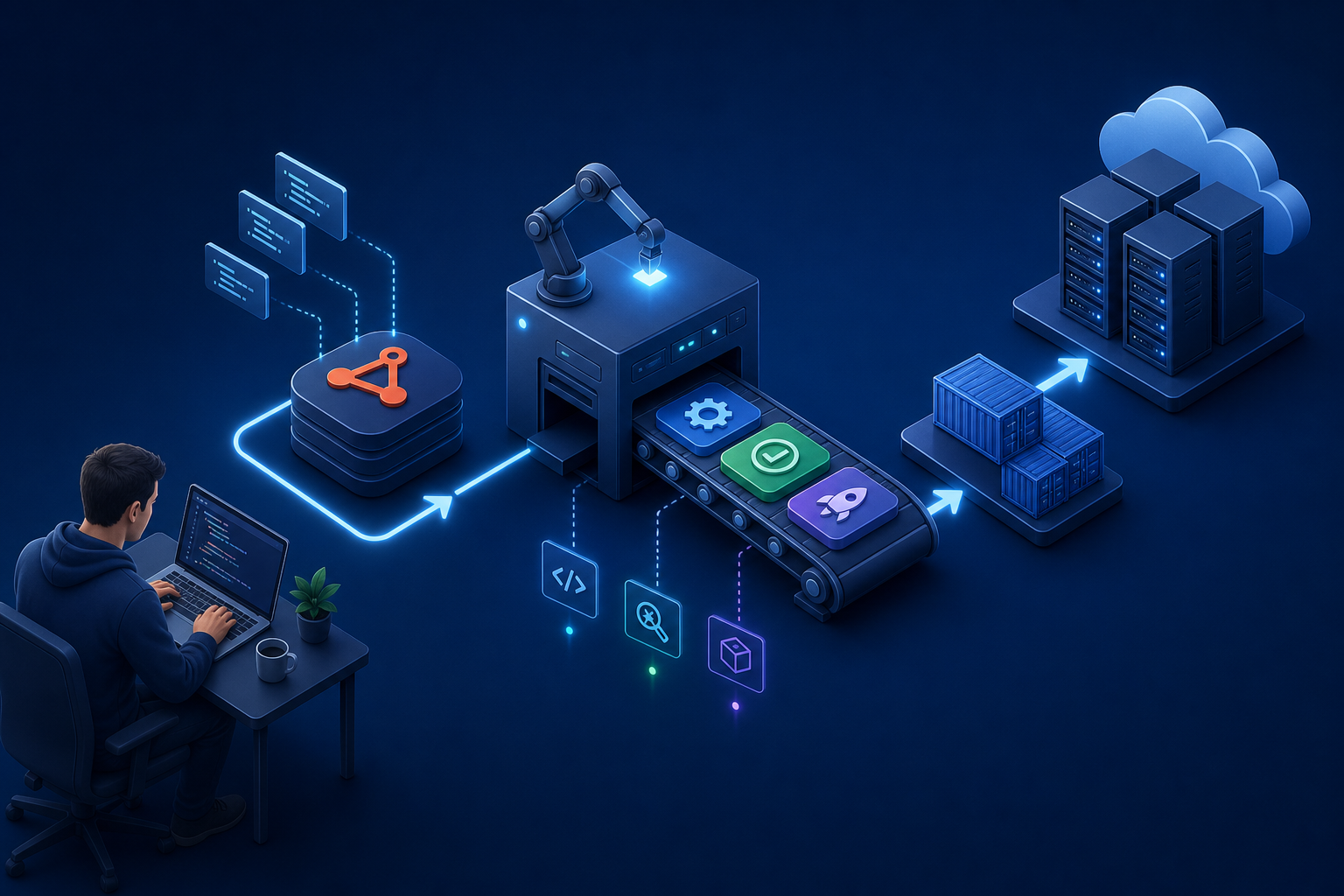
Jenkins is still one of the most common CI/CD platforms in enterprise environments. Developers push code; Jenkins builds, tests, packages, and deploys it. From an infrastructure engineer's perspective, the job is not just "install Jenkins" — it is designing agents, securing credentials, wiring Git triggers, integrating with Docker or Kubernetes, and making sure production deployments are repeatable and recoverable. This post walks through the full flow from a developer commit to a production release, then breaks down how to configure the pipeline, what infrastructure teams typically own, and the issues that show up most often in real environments. Part of my Infrastructure learning notes. Full guide: Jenkins CI/CD page. Related topics: Ansible, Docker & Kubernetes. Where the infrastructure engineer fits In most organizations, responsibilities split like this:Area Developer team Infrastructure / platform teamApplication code Owns Reviews deployment impactUnit tests Owns Provides CI runners and toolingJenkinsfile / pipeline logic Often co-owned Enforces standards, templates, librariesJenkins controller and agents Supports Owns installation, patching, capacityCredentials and secrets Uses Provisions and rotatesBuild artifacts and registries Consumes Operates artifact repo / container registryTarget servers or clusters Defines requirements Provisions network, IAM, deploy accessProduction approval gates Business / release owner Implements technical controlsInfrastructure engineers make the pipeline possible and safe. Developers make the pipeline useful for their app. End-to-end flow: developer push to production Here is the full lifecycle in a typical enterprise setup using Git, Jenkins, a container registry, and staged environments. Developer workstation | | git push (feature branch or main) v Git server (GitHub / GitLab / Bitbucket) | | webhook or polling trigger v Jenkins controller | | assigns job to agent with required label/tools v Jenkins agent (build node) | +--> Checkout source code +--> Install dependencies +--> Run unit tests +--> Run static analysis / security scan +--> Build artifact (JAR/WAR, zip, or Docker image) +--> Push artifact to registry (Nexus, Artifactory, ECR, GHCR) +--> Deploy to DEV (automatic) +--> Deploy to QA / STAGING (automatic or gated) +--> Manual approval for PRODUCTION +--> Deploy to PRODUCTION +--> Smoke tests / health checks +--> Notify team (email, Slack, Teams)Step-by-step narrative 1. Developer pushes code A developer commits to a feature branch and opens a pull request, or merges to main / develop depending on branching strategy. The push event is the starting point for automation. 2. Git server notifies Jenkins Most teams use a webhook from GitHub/GitLab to Jenkins. Alternative: Jenkins polls the repository on a schedule (less efficient, but works when webhooks are blocked by firewalls). 3. Jenkins controller receives the event The controller parses the payload (branch name, commit SHA, author) and decides which pipeline to run. Multibranch pipelines automatically create jobs per branch. 4. Agent selection The controller schedules the build on an agent that has the right label — for example linux && docker for container builds, or windows && msbuild for .NET apps. 5. Continuous Integration (CI) stages On the agent, Jenkins checks out the exact commit, runs tests, and fails fast if quality gates are not met. Failed builds should never proceed to deployment. 6. Artifact creation Successful builds produce a versioned artifact. For containerized apps, this is usually docker build followed by docker push to a private registry with an immutable tag such as myapp:1.4.2 or myapp:git-a1b2c3d. 7. Continuous Delivery / Deployment (CD) stages The same pipeline (or a downstream promotion pipeline) deploys the artifact to environments in order:DEV — every successful build on feature branches QA / STAGING — merges to develop or release branches PRODUCTION — tagged releases with manual approval8. Production verification After deployment, automated smoke tests hit health endpoints. Monitoring and alerting confirm the new version is stable. Rollback uses the previous known-good artifact tag. Jenkins architecture (what you actually deploy) Controller (formerly master) The controller is the brain:Stores job definitions and build history Schedules work to agents Serves the UI and API Holds credentials (encrypted) and system configurationInfrastructure notes:Run on a dedicated VM or hardened host — not on a developer laptop Back up $JENKINS_HOME regularly (jobs, credentials metadata, plugins) Keep controller patching on a maintenance schedule Restrict who has admin access; use RBACAgents (formerly slaves / nodes) Agents execute pipeline steps:Can be static VMs, ephemeral Docker containers, or Kubernetes pods Need outbound access to Git, registries, and deployment targets Should be rebuilt or recycled to avoid stale toolchainsCommon agent patterns:Pattern When to use Trade-offPermanent Linux VMs Stable toolchain, legacy apps Manual patching burdenDocker agents Clean environment per build Requires Docker on host or DinD setupKubernetes agents Cloud-native, elastic scale More moving partsSSH agents Remote hosts already in estate Network and SSH key managementPipeline configuration from an infrastructure perspective Modern Jenkins uses Pipeline as Code — a Jenkinsfile in the repository. Infrastructure teams usually provide:A shared library (vars/deployApp.groovy) for standard deploy steps Credential IDs that pipelines reference but never embed Agent labels documented for each team Quality gate rules (must pass tests, no critical CVEs)Example declarative Jenkinsfile Below is a representative pipeline for a containerized application deploying to staging automatically and production with approval. pipeline { agent { label 'linux && docker' } environment { APP_NAME = 'myapp' REGISTRY = 'registry.example.com' IMAGE_TAG = "${env.BUILD_NUMBER}-${env.GIT_COMMIT.take(7)}" DEV_URL = 'https://dev.myapp.example.com' STAGING_URL = 'https://staging.myapp.example.com' PROD_URL = 'https://myapp.example.com' } options { buildDiscarder(logRotator(numToKeepStr: '30')) timestamps() disableConcurrentBuilds() timeout(time: 45, unit: 'MINUTES') } triggers { // Git webhook is preferred; pollSCM is a fallback pollSCM('H/5 * * * *') } stages { stage('Checkout') { steps { checkout scm } } stage('Build & Unit Test') { steps { sh ''' python -m venv .venv . .venv/bin/activate pip install -r requirements.txt pytest --junitxml=reports/junit.xml ''' } post { always { junit 'reports/junit.xml' } } } stage('Build Docker Image') { steps { script { docker.build("${REGISTRY}/${APP_NAME}:${IMAGE_TAG}") } } } stage('Scan Image') { steps { sh ''' trivy image --severity HIGH,CRITICAL --exit-code 1 \ ${REGISTRY}/${APP_NAME}:${IMAGE_TAG} ''' } } stage('Push to Registry') { steps { withCredentials([usernamePassword( credentialsId: 'registry-credentials', usernameVariable: 'REG_USER', passwordVariable: 'REG_PASS' )]) { sh ''' echo "$REG_PASS" | docker login $REGISTRY -u "$REG_USER" --password-stdin docker push ${REGISTRY}/${APP_NAME}:${IMAGE_TAG} ''' } } } stage('Deploy to DEV') { when { branch 'develop' } steps { sshagent(credentials: ['dev-deploy-ssh-key']) { sh ''' ssh deploy@dev-host " docker pull ${REGISTRY}/${APP_NAME}:${IMAGE_TAG} && docker stop ${APP_NAME} || true && docker rm ${APP_NAME} || true && docker run -d --name ${APP_NAME} -p 8080:8080 \ ${REGISTRY}/${APP_NAME}:${IMAGE_TAG} " ''' } } } stage('Deploy to Staging') { when { branch 'main' } steps { sshagent(credentials: ['staging-deploy-ssh-key']) { sh ''' ssh deploy@staging-host " docker pull ${REGISTRY}/${APP_NAME}:${IMAGE_TAG} && /opt/scripts/rolling_deploy.sh ${APP_NAME} ${REGISTRY}/${APP_NAME}:${IMAGE_TAG} " ''' } } post { success { sh "curl -f ${STAGING_URL}/health || exit 1" } } } stage('Approve Production Deploy') { when { branch 'main' } steps { timeout(time: 24, unit: 'HOURS') { input message: 'Deploy to production?', ok: 'Deploy' } } } stage('Deploy to Production') { when { branch 'main' } steps { sshagent(credentials: ['prod-deploy-ssh-key']) { sh ''' ssh deploy@prod-host " docker pull ${REGISTRY}/${APP_NAME}:${IMAGE_TAG} && /opt/scripts/rolling_deploy.sh ${APP_NAME} ${REGISTRY}/${APP_NAME}:${IMAGE_TAG} " ''' } } post { success { sh "curl -f ${PROD_URL}/health || exit 1" } failure { mail to: 'ops-team@example.com', subject: "FAILED prod deploy: ${APP_NAME} ${IMAGE_TAG}", body: "Build ${env.BUILD_URL}" } } } } post { always { cleanWs() } } }What each infrastructure-owned piece does Agent label (linux && docker) Ensures the job lands on a node with Docker installed. Labels are how you separate build farms by OS, security zone, or toolchain. Credentials IDs registry-credentials, dev-deploy-ssh-key, etc. are stored in Jenkins credential store. Pipelines reference IDs only — never plaintext secrets in Git. Registry Infrastructure provisions the container registry, TLS certificates, retention policies, and robot accounts for CI push access. Deploy scripts on target hosts /opt/scripts/rolling_deploy.sh is often maintained by platform teams. It handles drain, pull, restart, and rollback in a consistent way across apps. Manual approval gate The input step pauses the pipeline until a release manager approves. Some teams replace this with change-management tickets or GitOps promotion. Alternative deployment targets The same CI stages apply; only the deploy step changes. Deploy with Ansible After building the artifact, Jenkins triggers an Ansible playbook: stage('Deploy with Ansible') { steps { ansiblePlaybook( playbook: 'deploy/app.yml', inventory: 'inventories/production', credentialsId: 'ansible-vault-password', extraVars: [ app_version: "${IMAGE_TAG}", target_env: 'production' ] ) } }Infrastructure owns inventory files, vault secrets, and SSH access from the Jenkins agent to managed nodes. Deploy to Kubernetes stage('Deploy to Kubernetes') { steps { withKubeConfig([credentialsId: 'k8s-prod-kubeconfig']) { sh ''' kubectl set image deployment/myapp \ myapp=${REGISTRY}/${APP_NAME}:${IMAGE_TAG} \ -n production kubectl rollout status deployment/myapp -n production --timeout=300s ''' } } }Here the infra team provisions namespaces, RBAC for the deploy service account, network policies, and ingress. Branching strategy and promotion model Pipelines behave differently based on branch rules:Branch Typical trigger Deploy targetfeature/* Pull request or push DEV onlydevelop Merge DEV + QAmain Merge Staging, then production with approvalrelease/* or git tag Tag push ProductionInfrastructure engineers document which branches map to which environments so teams do not accidentally deploy feature code to production. Security and compliance checklist Before any production pipeline goes live:Least privilege — Jenkins service accounts can deploy only to intended environments Secrets in credential store — never in Jenkinsfile or console output (use withCredentials and mask passwords) Immutable artifacts — tag images by commit SHA; do not reuse latest in production Scanning — SAST, dependency check, container image scan before push Audit trail — build logs, approver identity, artifact version deployed Network segmentation — production deploy agents may live in a restricted zone Plugin hygiene — remove unused plugins; patch Jenkins monthlyCommon issues and how to troubleshoot them These are the problems I see most often when supporting Jenkins in production. 1. Webhook not triggering builds Symptoms: Developer pushes code; nothing happens in Jenkins. Causes:Webhook URL wrong or blocked by firewall Jenkins URL not reachable from Git server (common with internal Jenkins) Multibranch job not indexed yet Branch filter excludes the pushed branchFix:Test webhook delivery in GitHub/GitLab webhook history Use a reverse proxy with valid TLS for Jenkins Run "Scan Multibranch Pipeline Now" Check when { branch ... } conditions in Jenkinsfile2. Agent offline or stuck builds in queue Symptoms: Builds wait forever in queue; "Waiting for next available executor." Causes:Agent VM powered off or SSH connection failed Agent labels do not match pipeline agent { label } All executors busy; insufficient capacity Docker cloud plugin cannot spawn new agentsFix:Check agent status on Jenkins dashboard Verify label expressions match Add agents or reduce concurrent builds Review Docker/Kubernetes agent template and resource limits3. Permission denied during deploy Symptoms: Build succeeds until SSH, kubectl, or registry push step. Causes:Expired credential or rotated SSH key not updated in Jenkins Wrong credential ID referenced in Jenkinsfile Target host firewall blocks Jenkins agent IP SELinux or sudo restrictions on deploy userFix:Re-save credentials and test with a minimal pipeline Confirm agent IP is allowed on port 22 or 6443 Use dedicated deploy user with forced command or Ansible for consistency4. "Works on agent" toolchain mismatches Symptoms: Builds pass on one agent, fail on another. Causes:Different Java/Python/Node versions across agents Missing compiler or library on new agent Cached dependencies masking problemsFix:Standardize agent images (golden VM or container agent template) Pin tool versions in pipeline (tools { jdk 'jdk17' }) Use declarative agent { docker { image '...' } } for reproducibility5. Docker build failures / no space left on device Symptoms: Intermittent docker build failures, pull errors. Causes:Docker layer cache filled disk on agent DinD (Docker-in-Docker) misconfiguration Registry storage fullFix:Schedule docker system prune on agents (carefully) Monitor disk on build nodes Use ephemeral agents that are destroyed after each build6. Flaky tests causing random pipeline failures Symptoms: Same commit passes then fails without code changes. Causes:Tests depend on external services or timing Shared test database state Parallel test race conditionsFix:Quarantine flaky tests; infrastructure provides stable test dependencies where possible Use test containers or dedicated QA environment for integration tests Retry only at the test framework level, not blind pipeline retries to production7. Production deploy succeeds but app is unhealthy Symptoms: Pipeline green; users report errors. Causes:Smoke test too shallow (/ returns 200 but API broken) Database migration not run ConfigMap / environment variables not updated Load balancer still draining old instancesFix:Add meaningful health checks post-deploy Separate migration stage with rollback plan Use blue/green or canary deploy scripts Verify monitoring alerts fire on error rate spikes8. Plugin upgrade breaks pipelines Symptoms: Jenkins upgrade or plugin update causes immediate mass failure. Causes:Deprecated pipeline steps Breaking API change in shared library Java version mismatch after controller upgradeFix:Test upgrades on staging Jenkins controller first Pin plugin versions; upgrade deliberately Keep controller and agent Java versions aligned9. Credential exposure in console logs Symptoms: Passwords or tokens visible in build output. Causes:Echoing environment variables Shell commands printing secrets Misconfigured withCredentials maskingFix:Never echo secrets; use --password-stdin patterns Enable Jenkins credentials masking Scan build logs in audits10. Slow pipelines blocking releases Symptoms: Full pipeline takes hours; teams bypass process. Causes:Sequential stages that could parallelize No caching for dependencies Oversized test suites run on every commitFix:Parallelize independent stages (parallel { ... }) Cache Maven/npm/pip directories on agents Run full regression only on merge to main; lighter checks on feature branchesOperational runbook (infrastructure daily/weekly tasks) DailyGlance at failed builds queue and agent connectivity Check disk and memory on controller and permanent agentsWeeklyReview plugin update advisories Validate backup restore test for $JENKINS_HOME Rotate short-lived tokens where policy requiresPer releaseConfirm artifact promoted matches approved git tag Verify monitoring dashboards for new version Document rollback artifact tag before deployHow Jenkins fits the rest of the stack Jenkins rarely operates alone. In infrastructure environments it typically connects to:Git — source of truth for code and Jenkinsfile Ansible — configuration and deploy automation on VMs Docker / Kubernetes — packaging and orchestration Artifact registry — immutable build outputs Monitoring — confirm deploy health after pipeline completesIf you are building a platform from scratch, start with one application, one pipeline, and one non-production environment. Get checkout → test → build → deploy working reliably before adding scanning, multi-environment promotion, and production approvals. Related readingAnsible automation — configuration management and deploy playbooks Docker & Kubernetes — container build and cluster deploy patterns Infrastructure overview — full topic indexIf you want a follow-up post on Jenkins shared libraries, Kubernetes agents, or GitOps with Argo CD alongside Jenkins, that is a natural next step once the basic pipeline is stable.